
Trepassey - Newfoundland and Labrador
Route 10
Coordinates: 46.7321° N, 53.3651° W
Trepassey originates from the French word trepasses, meaning the
'dead or departed'. It is believed that it
acquired this name due to the many shipwrecks
that have occurred off its coast. Also on the
Brittany coast of France there is a Baie des
Trepasses. Trepassey is the name of the harbour,
the bay and the community.
Spanish, Portuguese and French fishermen visited
the area in the early 1500s. Early English
settlement attempts failed, and it was not until
the latter part of the 1600s that the French
settled the area. Later fishermen from the West
Country of England arrived, to be followed by
large numbers of Irish and by the 1770s the
Irish formed the majority of the population.
Interesting Facts
- 1600s, Trepassey marks the area where the French and English areas of influence in Newfoundland meet.
- 1675, the French occupy one part of the Trepassey harbour and the English the other side.
- 1713, the Treaty of Utrecht gives control of Trepassey to England. Shortly thereafter, Trepassey becomes a major centre of the English migratory and bank fisheries.
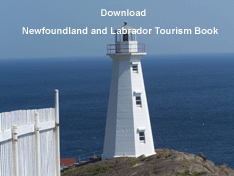
- 1821, the first lighthouse is built at Cape Pine, the southernmost point in Newfoundland.
- 1836, the population is listed as 247.
- 1884, population reaches 668.
- 1914, the Newfoundland Railway Branch Line is completed, linking Trepassey with St. Johns.
- 1919, United States Navy Curtis Flying Board (the NC-4) leaves Trepassey harbour on May 16 and flies to Portugal via the Azores, thus completing the first successful (although not non-stop) transatlantic flight.
- 1928, (June 28), after staying in Trepassey for three weeks, Amelia Earhart as a passenger aboard The Friendship, becomes the first woman to fly across the Atlantic Ocean.
- 1969, the community elects its first town council.
- 1991, the local fish plant closes putting over 600 people out of work.
Copyright © 2010, BNE-Web-Creations
Home ::
Avalon ::
Eastern ::
Central ::
Western ::
Labrador ::
Getting Here ::
Pictures ::
Contact Us ::
Site Map ::
Privacy Policy ::
Disclaimer ::
Terms Of Use